
A maths paper that gives every question a purpose
Build a maths test that checks understanding, leaves room for working and feels fair to your class. Follow practical tips for questions, marks and final review.
You have finished a chapter, the test is tomorrow, and a blank page is staring back at you. It is tempting to pick a few familiar questions and call it done. But a useful maths paper needs a little more thought: what should a student be able to show by the end of it?
Start with what you actually taught
Keep the textbook open beside your lesson notes. Write down the topics your class has practised and the skills you want to check. A chapter title alone is not enough. Two classes can reach the same chapter and still need very different tests.
- Choose the chapters and topics covered in class.
- Separate questions that test recall from questions that require a method.
- Leave out material you have not taught, unless you clearly label it as an optional challenge.
Give different kinds of thinking a place
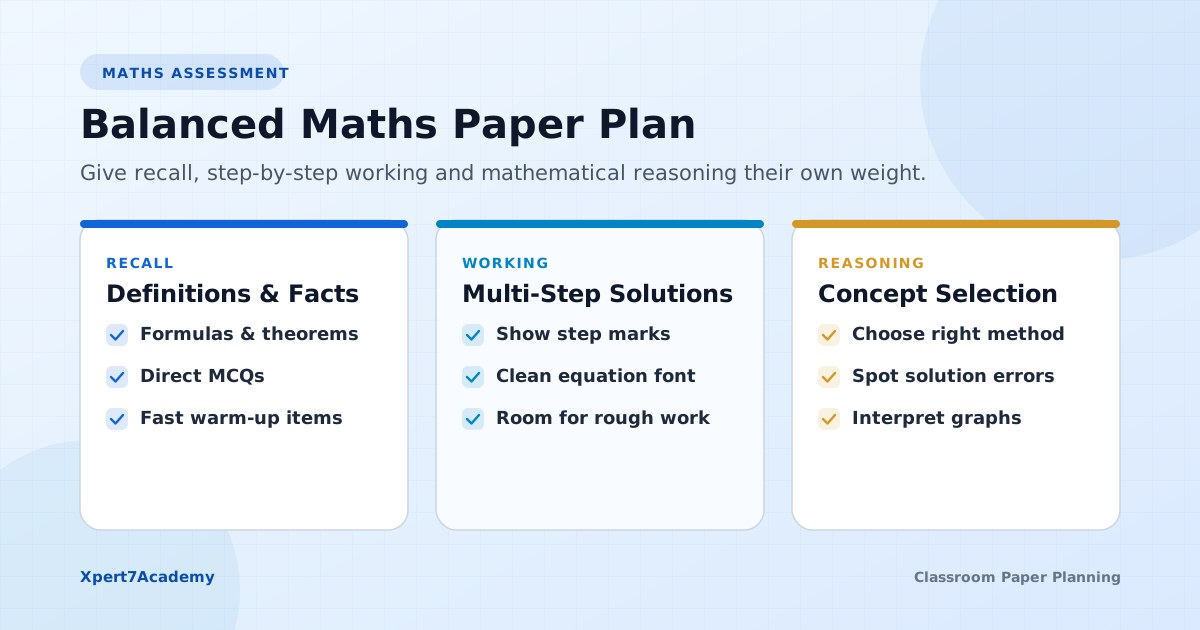
A student might remember a formula but struggle to decide when to use it. Another might make a small arithmetic mistake after choosing the right method. A mix of short answers, worked problems and explanation questions can help you see that difference. You do not need a fixed ratio for every test. Let the lesson goals guide the balance.
- Recall: name a shape, identify a property or state a rule.
- Working: solve a problem and show the steps.
- Reasoning: explain a choice or spot a mistake in a solution.
Make the marks tell a clear story
Decide what earns credit before students see the paper. If a question asks for several steps, make sure your marking notes recognise those steps. Avoid giving a long problem the same weight as a one-word answer simply because both fit on one line.
For a smaller assessment, use the chapter-wise test planning example to connect question quantities with the marks students actually attempt.
- Solve the paper yourself without looking at the answer key.
- Note where a student could use a different valid method.
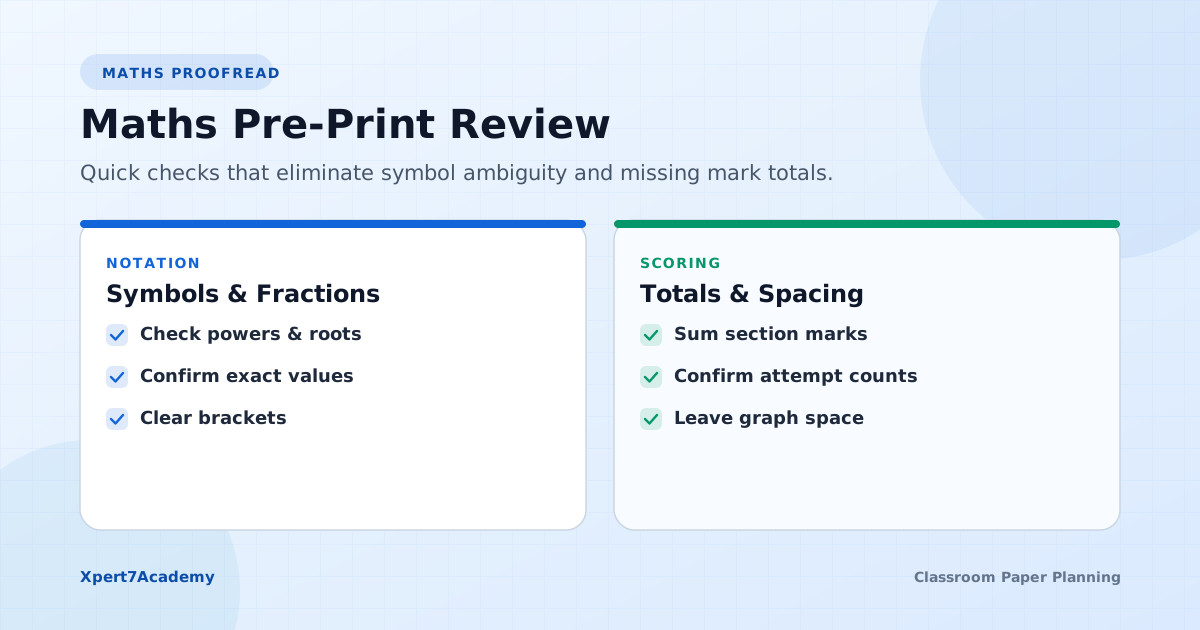
- Check that the marks add up to the total printed in the header.
Read the page as a student would
Look for cramped fractions, unclear diagrams and instructions that leave room for two interpretations. If students write on a separate answer sheet, say so. If they write on the paper, give longer calculations enough space. A tidy page cannot make a difficult question easy, but it can keep the layout from becoming another problem.
Build a small paper first
In Xpert7Academy, choose your curriculum, class and mathematics subject, then select from the chapters and question types available. Start with a short section and read it before adding more. Availability varies by syllabus and textbook, so check the choices shown in your account instead of assuming every topic is covered.
Let the results shape the next lesson
After marking, look beyond the total score. Did several students miss the same step? Did they choose a formula correctly but use the wrong units? Those patterns give you a practical starting point for revision. Keep one or two useful questions for a follow-up lesson, rather than repeating the whole test.
Start with a small paper.
Try the full Automated Test Generation free for 10 days after signup.
Saving and customization are included in the demo. Continue afterwards with Rs. 3,000 for 3 months (orig. Rs. 4,500), Rs. 5,000 for 6 months (orig. Rs. 7,000), or Rs. 7,000 for 1 year Full Session (orig. Rs. 10,000).
Before choosing questions, check your section marks with the free planner. It accounts for optional questions as well as compulsory ones.