
How to make a chapter-wise test paper that fits your lesson
Build a chapter-wise test with a clear scope, a worked marks plan and balanced topic coverage. Follow the Xpert7Academy workflow from book selection to PDF.
A chapter-wise test works best when it answers one useful question: what can this class do with the material we have just taught? It should not quietly turn into a full-book examination. Decide the scope, the time and the kind of evidence you want, then choose questions that fit. This makes the test easier to prepare, easier to mark and more useful when you plan the next lesson.
Name the scope in a sentence
Write a brief such as “Class 9 mathematics, the two topics practised this week, 30 marks, one lesson.” Add any exclusions, such as an exercise you have not reached or a method you have not introduced. A clear brief helps a colleague review the draft without guessing what your class knows.
Use the class and book directory to confirm the content source. Xpert7Academy includes PTB, Federal, AFAQ SNC and Oxford SNC, with different class and book ranges. If you are using Federal material, start with the Federal practice-paper guide. A similar subject label from another curriculum is not a substitute for checking your own book.
Select the taught topics, not just the chapter heading
A chapter can contain several skills, and your class may be ready for only some of them. In the studio, choose the curriculum, class and subject, then Chapters and Topics. Use those topic choices to keep the test within your brief. If you select several chapters for revision, decide which parts need attention instead of accepting a question from every heading automatically.
This matters when students have practised a routine but not its application in an unfamiliar setting. Include an application question only when it belongs to the learning you want to assess. You can use a teacher-designed extension, but label and mark it appropriately rather than letting an unexpected task distort the core test.
Use a marks plan you can explain
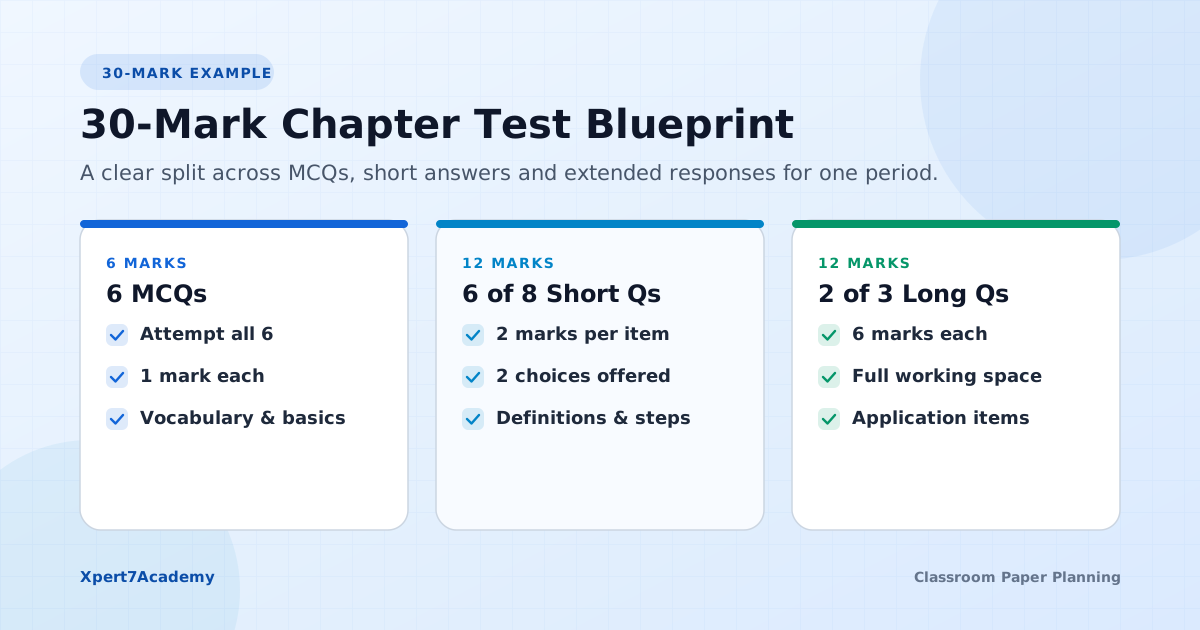
For example, a 30-mark classroom test might contain six one-mark MCQs, six two-mark short questions and two six-mark longer questions. The sections contribute 6, 12 and 12 marks. Use different quantities when the subject calls for it. A language exercise, a calculation test and a diagram task do not take equal time simply because they carry equal marks.
Check the arithmetic in the paper marks calculator. If students attempt three of four short questions, the section total uses three attempted questions. Print that instruction clearly and make the header total match. The maths paper planning guide explains how marks can recognise working rather than just the final number.
- Estimate reading and working time, not only question count.
- Make compulsory questions and choices easy to distinguish.
- Keep a marking note for any answer with several valid methods.
Choose how you want to select questions
The question-selection step offers two routes. Balanced random selection and manual selection serve different needs. Random selection can give you a varied draft across eligible topics. Manual selection lets you inspect a particular topic and keep the questions you want. Neither replaces a final teaching check.
For a short lesson quiz, start with a small section and inspect what it covers. If several items test the same routine, remove or replace the repetition unless it serves a clear purpose. Leave space for students to show working where you need to see their method. Answer-writing lines are useful for brief written work; long calculations may need more space than a few ruled lines.
Review the paper as a whole
Read the completed test from the first instruction to the final question. A collection of suitable questions can still make an unsuitable paper if the total work is too long or the instructions conflict. Check that one answer does not give away another, and that a question needing a diagram has a readable diagram on the page.
Review English or Urdu wording in the selected medium, then inspect the PDF. For bilingual papers, follow the medium and printing checklist. Do not assume a tidy screen preview guarantees clear text on the final sheet. Keep your own answers nearby while reviewing the questions and any stored answer key.
Use the results to choose the next small step
After marking, note the question that caused the most difficulty and why. Was the content unfamiliar, the method incomplete or the instruction unclear? A short follow-up question can check that specific issue without repeating the whole test. Keep the original paper and a note about what you would change.
The monthly test planning guide shows how to connect those small checks to a wider routine. During the 10-day demo or active paid access, you can save a paper in your workspace and return to it while access remains available. Begin with a manageable test; a useful chapter check does not need to fill every page.
Start with a small paper.
Try the full Automated Test Generation free for 10 days after signup.
Saving and customization are included in the demo. Continue afterwards with Rs. 3,000 for 3 months (orig. Rs. 4,500), Rs. 5,000 for 6 months (orig. Rs. 7,000), or Rs. 7,000 for 1 year Full Session (orig. Rs. 10,000).
Before choosing questions, check your section marks with the free planner. It accounts for optional questions as well as compulsory ones.