
A clearer Urdu paper for younger learners
Plan a primary Urdu test with familiar instructions, readable text and room for children to show what they know. Review wording, answer space and print layout.
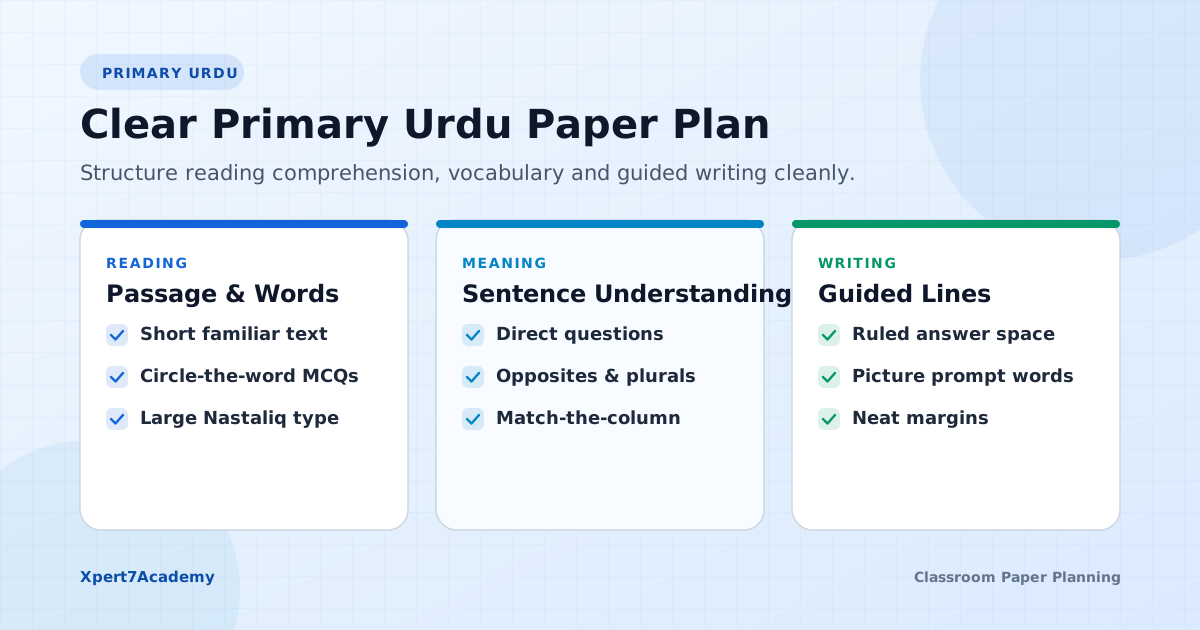
A child can know the answer and still get stuck on the instruction. When you are making an Urdu paper for younger learners, the wording and page layout deserve as much attention as the questions. The aim is to find out what children understand, without making them first solve the puzzle of how to answer.
Keep the instructions familiar
Use the same instruction words children hear in class. Read each prompt aloud. Does it ask for one clear action, or does it quietly ask for three things at once? If you need children to circle an answer, complete a word or write a sentence, make that action easy to identify.
- Use a short instruction for each activity.
- Keep question numbering easy to follow.
- Use a worked example when the response format is unfamiliar, without giving away a test answer.
Choose tasks with a purpose
Start with the reading and writing you have practised recently. A matching task might check word recognition, while a short written answer asks a child to produce language independently. Both can be useful, but they tell you different things. Choose formats available for your selected subject rather than filling the page with every format you can find.
- List the words, passages or sentence patterns covered in class.
- Choose a small number of tasks that check those skills.
- Remove repeated questions that ask children to do essentially the same thing.
Let the text breathe
Urdu needs care in print. Check that joined letters, punctuation and vowel marks are readable at the final print size. Leave enough vertical space so lines do not run into each other. A worksheet that looks comfortable on a large screen can feel crowded on an ordinary sheet of paper.
Before printing a class set, follow the English and Urdu printing checklist to review joined letters, page breaks and diagram labels in the saved PDF.
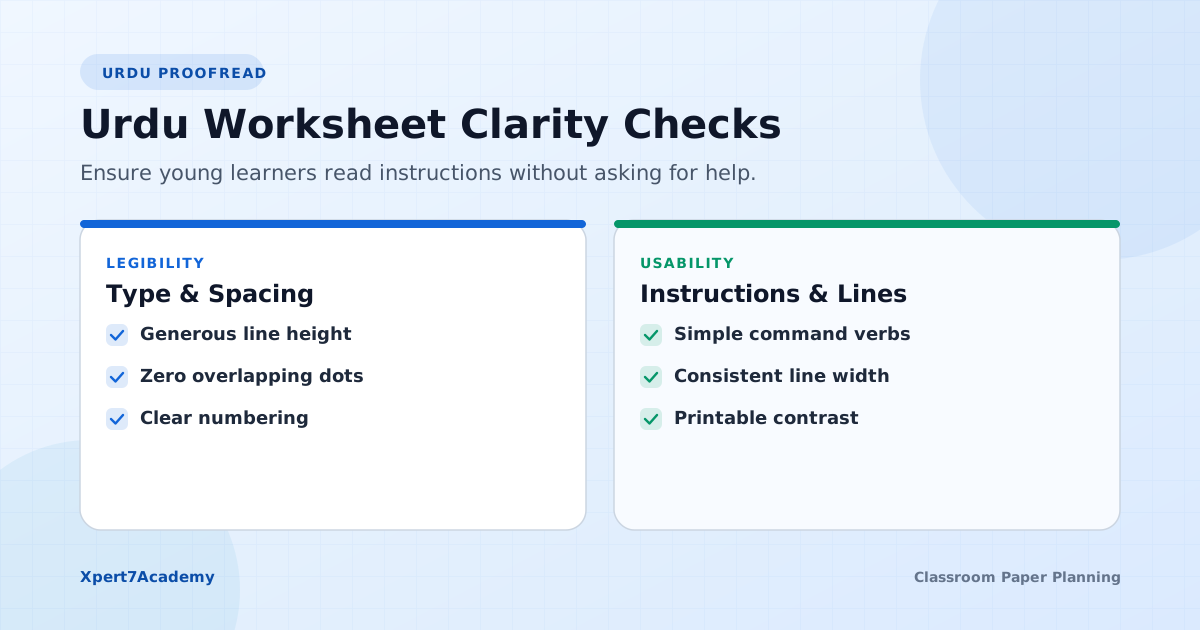
Match the answer space to the answer
A single word needs less space than a sentence. A task that asks for several sentences needs a place to write them. Before printing, imagine a child with larger handwriting filling in the page. If you are using a separate notebook or answer sheet, make that instruction clear at the start.
Use the generator as a starting point
Select your curriculum, class, Urdu subject and the relevant chapters in Xpert7Academy. Review the available questions before adding them. Check the language, order and total marks, then use print preview. The 10-day free demo lets you build, customize and save a paper. A paid plan keeps these features available afterward.
Keep one final classroom check
Before handing out the paper, ask yourself whether a child can tell where to begin and what to do next. After the test, notice whether mistakes came from the lesson content or from confusing instructions. That small distinction can make your next paper much clearer.
پرچہ تیار کرتے وقت سوالات کی زبان سادہ رکھیں۔ ہدایات واضح ہوں، تحریر پڑھنے میں آسان ہو اور بچوں کے لیے جواب لکھنے کی مناسب جگہ موجود ہو۔
Start with a small paper.
Try the full Automated Test Generation free for 10 days after signup.
Saving and customization are included in the demo. Continue afterwards with Rs. 3,000 for 3 months (orig. Rs. 4,500), Rs. 5,000 for 6 months (orig. Rs. 7,000), or Rs. 7,000 for 1 year Full Session (orig. Rs. 10,000).
Before choosing questions, check your section marks with the free planner. It accounts for optional questions as well as compulsory ones.