
A practical way to plan PEF QAT practice papers
Find official PEF content books and QAT model papers, check the applicable class and session, and plan a reviewed practice test for your students.
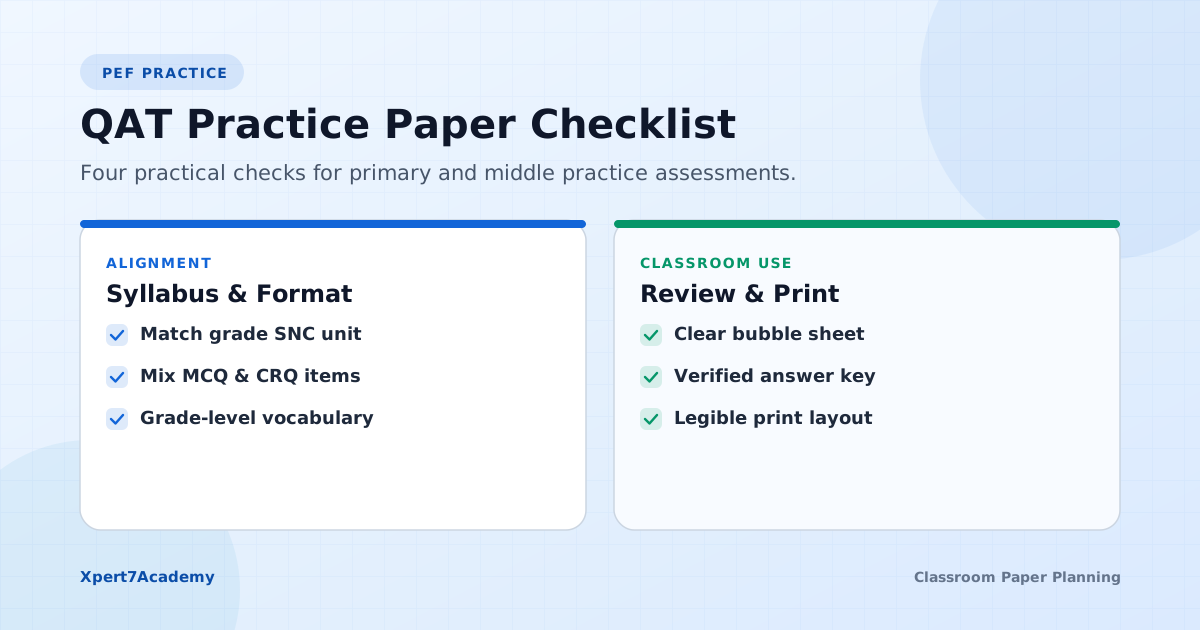
A folder of model papers can feel like preparation. The harder part is deciding what your class needs to practise next. Before copying a section or repeating a familiar set of questions, match the official content to the lessons your students have studied. Then build a practice paper that gives you useful information about their learning.
Find the official PEF material first
QAT means Quality Assurance Test in the Punjab Education Foundation context. The PEF Academic Development Unit downloads page provides content books and model-paper resources. Choose the material for the applicable class and academic session, and check later notices before planning a mock.
The PEF QAT cycle overview separates content and model-paper preparation from the actual assessment process. Treat a model as a reference for practice, not a prediction of the questions students will receive.
Check taught content against the assessment scope
Make two short lists: content included in the applicable reference, and content your class has actually studied. A weekly lesson check can focus on the overlap. A broader mock may need a revision plan first if substantial included material has not yet been taught.
Use the content book to check scope, then compare the question demands in the model. Do not infer a complete syllabus from a few example questions. Avoid coaching students to memorize one model paper as if it were the assessment itself.
Decide what this practice paper should tell you
Choose a clear purpose. Are you checking a recently taught concept, revisiting a common mistake or rehearsing the applicable assessment structure? A short diagnostic test and a full mock need different quantities, timing and follow-up.
For a diagnostic test, include a question students should recognize and another that asks them to use the same idea in a different setting. Read the answers to see how they reasoned. For a mock, derive section quantities, choices and marks from the applicable official material rather than using a generic template.
Check whether the available books meet your needs
Use the Xpert7Academy book and chapter directory to compare the available PTB, Federal, AFAQ SNC and Oxford SNC books with your teaching material. These curriculum labels do not certify QAT coverage. Inspect the questions and medium you need during the 10-day demo.
Use manual selection when you need to read each question before adding it. Balanced random selection can help draft across selected topics, but it does not enforce PEF content-book quotas or an official QAT pattern automatically. Where the bank does not cover a required task, record the gap and prepare appropriate material separately.
Review the paper and marking notes together
Check attempted totals with the marks calculator. Read each question in the language your students will use, inspect diagrams and confirm that the intended answer earns the marks shown. Stored answer information varies, so prepare missing marking notes before the assessment.
Print or save one review copy before producing a class set. After marking, group the recurring mistakes by concept. Use that record for the next lesson and a focused follow-up test instead of simply giving students the same paper again.
Start with a small paper.
Try the full Automated Test Generation free for 10 days after signup.
Saving and customization are included in the demo. Continue afterwards with Rs. 3,000 for 3 months (orig. Rs. 4,500), Rs. 5,000 for 6 months (orig. Rs. 7,000), or Rs. 7,000 for 1 year Full Session (orig. Rs. 10,000).
Before choosing questions, check your section marks with the free planner. It accounts for optional questions as well as compulsory ones.