
Manual or balanced random questions: which to choose?
Compare Xpert7Academy’s manual and balanced random question selection. Learn when to browse topic cards, how to review a random draft and avoid repeated questions.
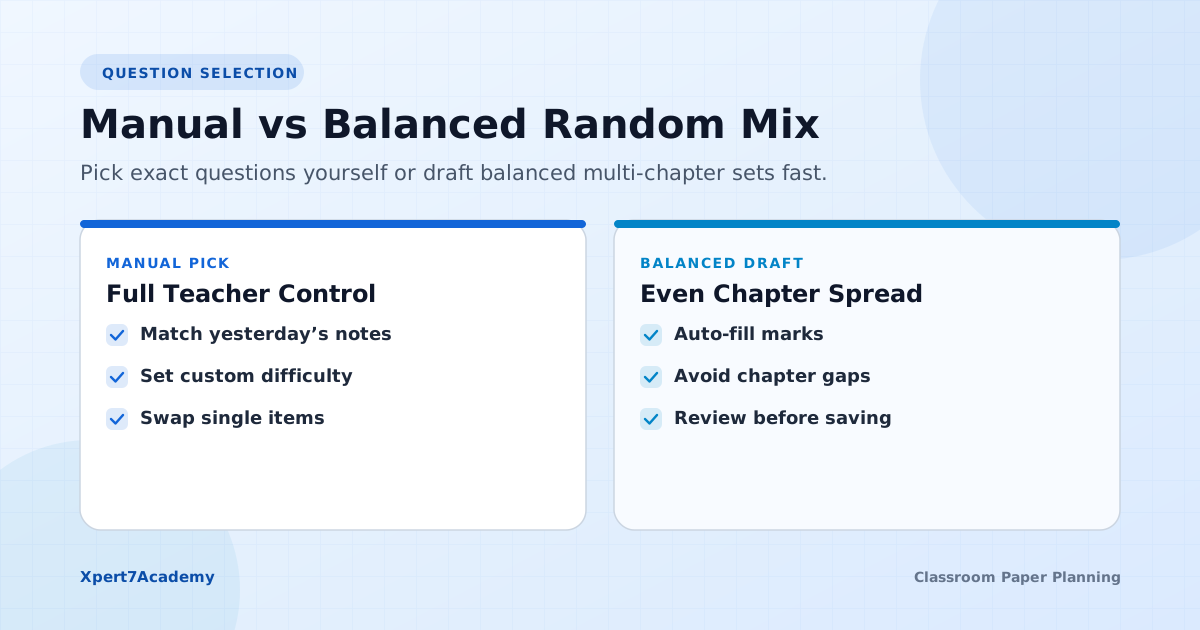
Sometimes you know exactly which exercise you want in a test. Sometimes you want a fresh selection across the topics your class has covered. Those are different tasks, which is why Xpert7Academy offers manual selection and balanced random selection. The choice changes how you assemble the draft. You still decide whether the questions, marks and instructions make a fair assessment for your students.
Set the same scope before choosing either method
Choose the curriculum, class, subject, chapters and topics first. Review the question types and sources available for those selections. The chapter test guide explains how a short scope and marks plan keep the draft focused. If the eligible material is wrong, changing the selection method will not make it match your lesson.
Think about the response you need to see. An MCQ can check whether a student distinguishes two ideas; a written question can show how the student explains or calculates. Choose the type for that purpose rather than because one method returns more questions. The studio’s available type tabs come from the selected content, so the list can change when you change topics.
Use balanced random selection for a varied starting draft
In balanced random selection, request a quantity for the chosen question type. The selection logic distributes the request across eligible topics and adjusts when a topic does not have enough matching questions. This helps avoid filling a multi-topic section entirely from one large topic bank. If very few topics or questions are eligible, the result has less room to vary.
The word “balanced” refers to topic allocation. It does not mean equal difficulty, equal reading time, guaranteed learning-outcome coverage or an official board pattern. Read the result before adding it. A set of ten questions may cover several topics and still repeat the same kind of routine. Replace unsuitable items rather than treating randomness as a teaching decision.
Use manual selection when the individual question matters
Open Manual selection and choose a question-type tab. Its chapter and topic cards organise the available material. Open a topic to browse its questions in the selection dialog, choose the items you want and confirm. Repeat for other topics, then move to another question type when needed. Your selections are recorded as you work through the topic dialogs.
This route is useful for a focused revision exercise, a question with a diagram, or a paper needing careful bilingual wording. Follow the English and Urdu print checks while inspecting your candidates. Choose questions for the skill they test, not simply because the wording looks familiar. Keep a note of why an item belongs in the paper if a colleague will review it.
Review repeated skills, not just repeated question IDs
Two questions can have different wording and still test the same step. In a short paper, that can take space away from another important skill. Read the whole section and group questions mentally by what a student must do. Keep deliberate practice repetitions when they serve the lesson; remove accidental repetitions that add little evidence.
For MCQs, review the stem, options and answer key using the MCQ writing checklist. In manual selection, avoid keeping several items merely because they all look easy to mark. In a random draft, watch for the same method appearing repeatedly with different numbers. Topic allocation alone cannot spot every teaching-level duplication.
Set marks and writing space after inspecting the work
Once you know which questions belong in the section, set marks, attempt choices and answer-writing lines. Check the attempted total in the marks planner. A section containing eight questions with a choice of five needs instructions and marks based on five attempted questions, not eight.
Allow enough room for the response. A two-mark definition and a two-mark calculation may use different amounts of space even if they contribute the same marks. Inspect long questions for subparts and review the heading students will read. The small settings matter most when they make the required action clear, rather than simply making the page look busier.
Choose a method you can review comfortably
Use a random draft when you want variety across known topics and can review the returned set. Use manual selection when you need to inspect and choose the individual items. You can use different methods for different sections; keep the overall marks plan beside you so the paper remains coherent.
Both routes work with available Federal material as well as the other supported curricula. Start with the Federal class directory if that is the source you teach. New accounts can try the full studio for 10 days, including customization and saving. Build a short paper with each method during that hour and keep the one that suits your preparation routine.
Start with a small paper.
Try the full Automated Test Generation free for 10 days after signup.
Saving and customization are included in the demo. Continue afterwards with Rs. 3,000 for 3 months (orig. Rs. 4,500), Rs. 5,000 for 6 months (orig. Rs. 7,000), or Rs. 7,000 for 1 year Full Session (orig. Rs. 10,000).
Before choosing questions, check your section marks with the free planner. It accounts for optional questions as well as compulsory ones.