
Physics for Class 9: chapters that carry the most weight
Planning a Class 9 physics test? See how to weight chapters by the kind of thinking they teach, definitions, numericals and diagrams, instead of guessing.
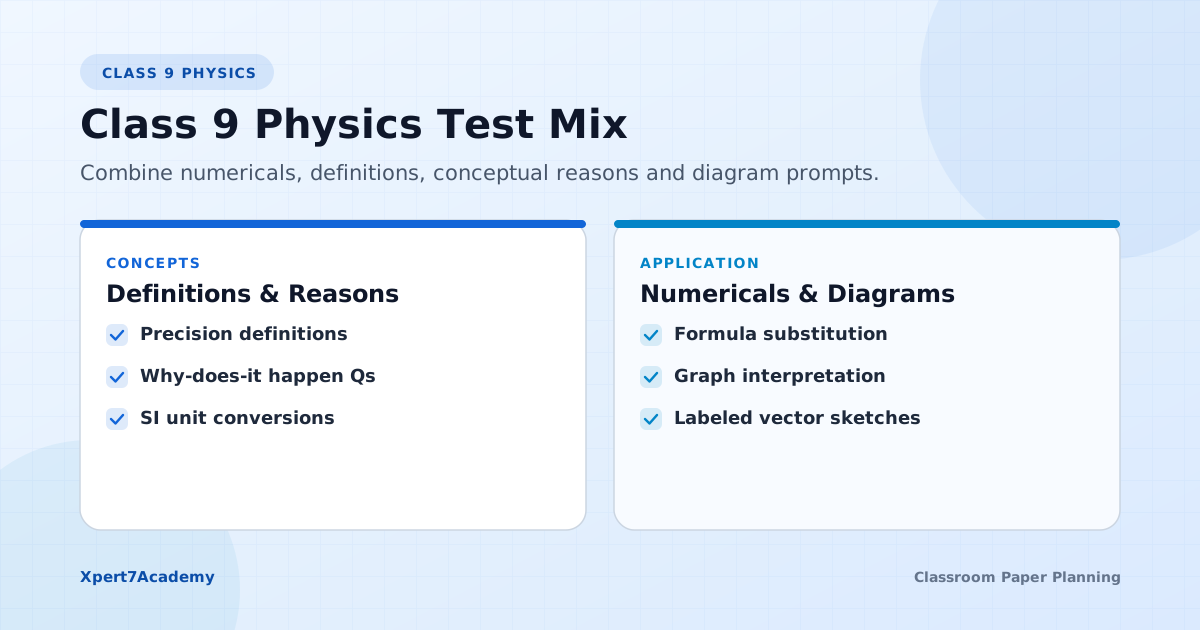
A Class 9 physics book looks long until you sort it by the kind of thinking it teaches. Some chapters live on definitions, some on numericals, and a few on labelled diagrams. Once you see that, a balanced test plans itself, and revision week stops feeling like a scramble.
Split the book into three question types
Go through your taught chapters and mark each one as mostly recall, mostly numerical or mostly conceptual. A chapter on units and measurement is recall-heavy. Kinematics and work–energy carry numericals. Turn-effect and gravitation mix concepts with diagrams. This fifteen-minute sort tells you where the marks should sit.
Turn a selected topic into a manageable assessment with the chapter-wise test workflow, then check the calculations and diagrams before adding more questions.
- Recall chapters: definitions, units, true-false style checks.
- Numerical chapters: at least one worked question per test.
- Diagram chapters: labelling or ray-diagram questions.
Give numericals a fixed share
Physics students lose the most marks where working is required. If your test has thirty marks, reserve roughly a third for numericals and say so in the instructions. Students then know that showing steps matters, and your marking becomes faster because the working is on the page.
- Choose two or three numerical questions covering different formulas.
- Keep the numbers simple enough for the time you allow.
- Print the marking steps for yourself before the test day.
Test diagrams the honest way
A diagram question should ask students to draw or label, not to describe a picture they remember. Copying a textbook figure into a question and asking for an explanation is fine; asking them to name the figure from memory teaches nothing new. Keep one diagram question per test and mark the labels strictly.
- Ask for the labelled diagram, not its name.
- Accept correct alternative label positions.
- Decide in advance how much partial credit a half-labelled diagram earns.
Cover every taught chapter at least once a term
It is tempting to test the same three chapters repeatedly because they mark quickly. Students notice. Rotate coverage so each taught chapter appears in at least one test across the term, even if it earns only two marks in a short quiz. Chapter check-boxes in Xpert7Academy make the rotation visible, tick what you tested, and the untouched chapters stand out next month.
A two-page pattern that works
Try this structure for a fifty-mark monthly test: ten one-mark definitions spread across all taught chapters, three mid-length conceptual questions, and two numericals worth six marks each with internal steps. It fits a forty-minute period, prints on two A4 pages, and leaves room for a short revision lesson before you hand it back.
Start with a small paper.
Try the full Automated Test Generation free for 10 days after signup.
Saving and customization are included in the demo. Continue afterwards with Rs. 3,000 for 3 months (orig. Rs. 4,500), Rs. 5,000 for 6 months (orig. Rs. 7,000), or Rs. 7,000 for 1 year Full Session (orig. Rs. 10,000).
Before choosing questions, check your section marks with the free planner. It accounts for optional questions as well as compulsory ones.