
Board pattern vs classroom test: what to borrow, what to skip
Board papers solve a different problem than your Friday test. See which parts of the board pattern help a class test, and which to leave out.
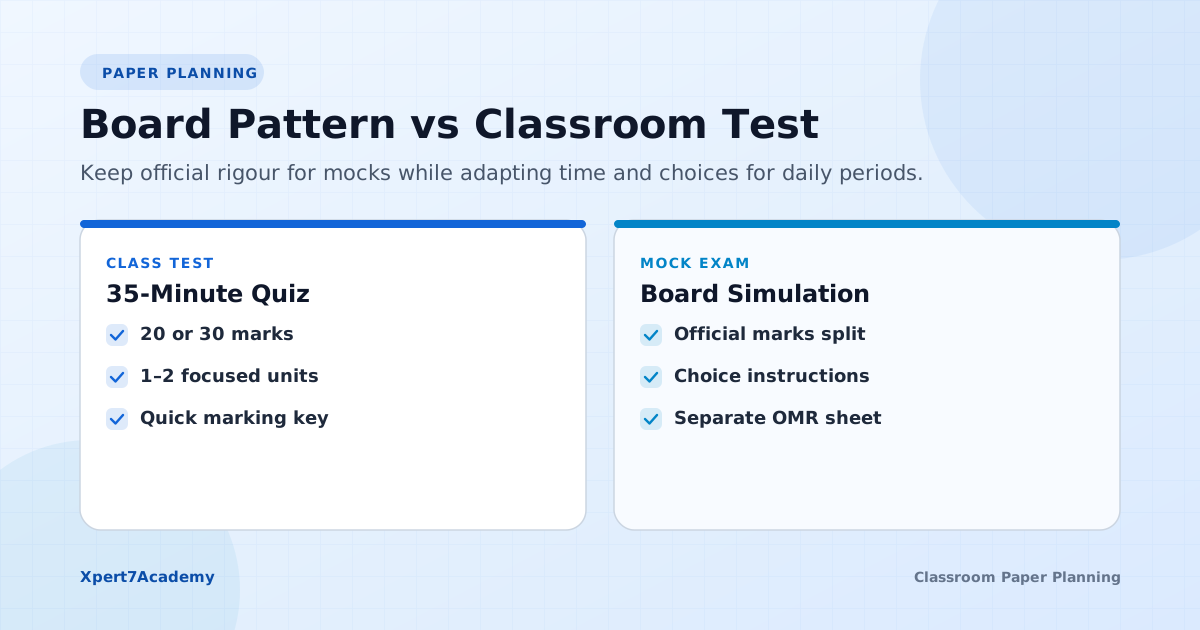
Teachers are told to make tests 'according to the board pattern', and it is good advice, up to a point. A board paper is written for a three-hour national exam taken after two years of syllabus. Your Friday test covers four chapters and forty minutes. Copying the format without copying its purpose gives you the worst of both.
What the board pattern gets right
Sectioning is the board's best idea. Grouping questions into objective, short and long sections tells students what kind of answer each part expects, and it makes your marking cleaner. The 'attempt any N of M' choice system is the second good idea, it reduces panic and lets strong students show range.
For Federal material, follow the guide to Federal practice-paper preparation and keep book selection separate from the official assessment-framework check.
For a step-by-step reference check, read how to use pairing schemes and model papers before choosing section quantities.
- Named sections with separate instructions.
- Marks printed beside every question.
- Internal choice within a question type.
What you should deliberately skip
Board papers spread questions across the whole syllabus evenly because they must, once a year, certify everything. Your classroom test exists to check what you taught this month. You do not need every chapter represented, and a tough unseen question that would be fair after two years of study can be discouraging after one unit.
- Full-syllabus coverage in every test.
- Unseen passage questions before students are ready.
- Three-hour length scaled down by cutting breaks and reading time.
Scale the timing honestly
A rough rule: board papers allow about a minute and a half per mark. For younger classes and shorter tests, two minutes per mark is more realistic once you include reading time. Give the timing a quick rehearsal, write the test yourself and clock it. Whatever takes you ten minutes will take most students twenty.
- Attempt your own paper with a timer.
- Multiply your reading-and-writing time by two for the class.
- Round the total to a period you actually have.
Introduce board style in steps
If you teach Class 9 or 10, spend the first term with simple class tests. In the second term, make one monthly test follow the board's section layout with the marks your chapters can support. By the send-up exam, students should feel the real pattern is familiar rather than frightening.
A pattern is a frame, not a rulebook
Inspectors and head teachers rarely ask whether your class test matched a board's layout. They ask whether it matched what you taught. Use the board's sections where they help, keep your own content choices, and say in the instructions exactly what students must attempt.
Start with a small paper.
Try the full Automated Test Generation free for 10 days after signup.
Saving and customization are included in the demo. Continue afterwards with Rs. 3,000 for 3 months (orig. Rs. 4,500), Rs. 5,000 for 6 months (orig. Rs. 7,000), or Rs. 7,000 for 1 year Full Session (orig. Rs. 10,000).
Before choosing questions, check your section marks with the free planner. It accounts for optional questions as well as compulsory ones.